
Clarified butter
Butter that has had the water and the milk taken out of it, so that it can get hot without turning bitter and black. If you have ever burnt butter and wondered what you did wrong: nothing. You used the wrong butter.
Why butter burns
Butter is not one thing. It is fat, plus water, plus milk solids — and the milk solids are the problem. They are proteins and milk sugar, and they scorch. This is why whole butter starts to blacken and taste bitter somewhere around 120–140 °C, which is well below the temperature you need for frying anything properly.
Take the water and the solids out and what remains is almost pure butterfat, which holds to roughly 180 °C before it complains. Same flavour. Same butter. It simply no longer contains the parts that were catching fire.
So when somebody tells you that butter burns and you should use the oil: my friends, the butter did not burn. The milk burned. You are blaming the wrong part.
“Hot, but not furious. We want golden, not burned. There is a difference. One is Milan. The other is Pompei.”
— Episode Two
How to do it
-
Melt it gently, and then leave it alone
Small heavy pan, the lowest heat you can manage. Do not stir. Do not let it bubble hard. After a few minutes it will sort itself into three layers, because you let it: white foam floating on top, clear gold in the middle, milky sediment sitting on the bottom.

The three layers, shown in glass so you can actually see them: foam on top, clear gold in the middle, milk solids on the bottom. In your pan they sit exactly the same way. -
Skim the foam off the top
Lift the white foam away with a spoon and throw it out. That is milk protein, and it is the first thing that will burn — removing it is the whole point.
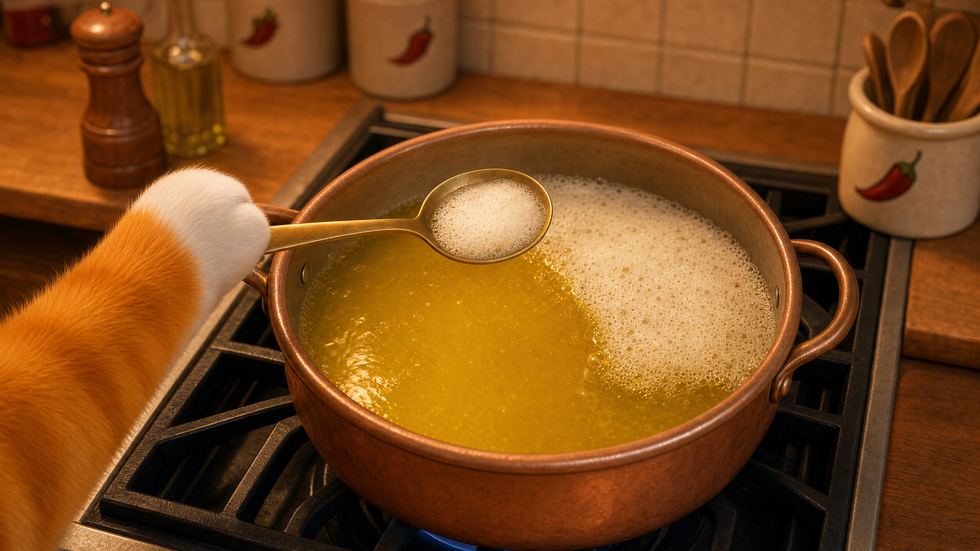
Lift it off and throw it away. That foam is milk protein, and it is the first thing that will burn. -
Pour off the gold, leave the milk behind
Pour the clear golden fat slowly into a clean jar and stop before the milky white layer at the bottom comes with it. Through a fine sieve or a piece of muslin if you want it perfect. What stays in the pan is water and milk solids — precisely the things you came here to remove.
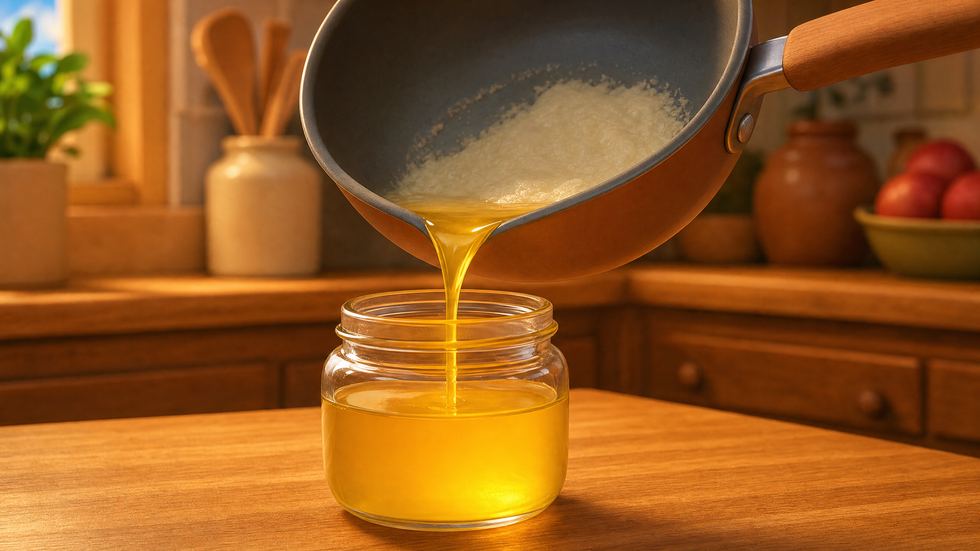
Pour slowly and stop early. What stays behind in the pan is exactly what you came here to remove. -
Keep it
It sets firm and pale gold, and it lasts for months in the fridge — because the water and the milk solids are what go bad, and you have just poured them down the sink. This is butter that waits for you.
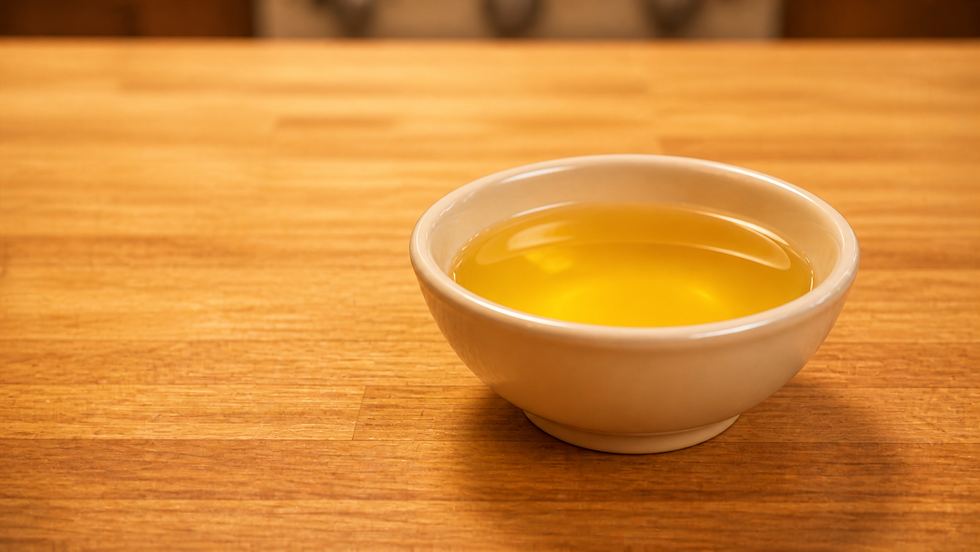
Clear, gold, and free of the two things that go bad. This is butter that waits for you.
When it goes wrong
- It went brown while it was melting
- The heat was too high. Brown butter is delicious and it is a completely different ingredient — the solids have toasted rather than been removed. Enjoy it on something, but it will not fry like clarified butter.
- My jar has a cloudy layer at the bottom
- Some sediment came over with the pour. It is harmless, but it will scorch in a hot pan. Chill the jar, lift out the solid gold disc, and leave the cloudy part behind.
- It looks grainy after chilling
- Normal. Butterfat crystallises unevenly depending on how fast it cooled. It melts clear again the moment it meets a pan.
Where you will need this
Anywhere you want the flavour of butter at a temperature butter cannot normally survive. Above all: cotoletta alla Milanese, which is fried in butter and never in oil — a thick veal chop needs five to seven minutes a side at 160–180 °C, and whole butter would be black long before the middle was ready. I do not want to discuss this. I want you to be correct.
Put it to work. → Cotoletta alla Milanese — the dish this fat exists for.“Clarified butter. Clean. Golden. Stable. This is not the moment for chaos. This is the moment where the cotoletta enters public life.”
— Episode Two
A small honesty, because this is an Academy and not a television programme: historically, and still in some Milanese kitchens, the cutlet was fried in plain butter with the browned butter spooned over at the end. Clarifying is the modern refinement that gives you control of the heat. Both are defensible. One is much harder to ruin.