
Cooking the pasta
Everybody believes this part is free. It is not free. More dishes are lost here, before the sauce has even arrived, than at any other moment in the kitchen — and the worst of it is that nobody notices, because the pasta looks fine sitting there in the colander.
The rule everybody knows
One litre of water. One hundred grams of pasta. Ten grams of salt. In Italy we say it as a number — 1–10–100 — and it is taught in every school, repeated in every kitchen, printed on the side of every packet. It is a good rule. Follow it and nothing bad will happen to you.
I do not follow it. Let me tell you why, because the reason is not rebellion. It is sauce.
Why my pot is smaller than yours
The water is not a bath. It is where the pasta leaves its starch, and that starch is the thing your sauce will later hold on to. Put the same pasta in half the water and the water comes out twice as strong — cloudy, thick, useful. Put it in a lake and you have made a lake.
The objection arrives immediately, and it always arrives from someone's aunt: in less water the pasta will stick, it will turn to glue, it will be a tragedy. It will not. Pasta sticks exactly as much in a lake as in a puddle.
What stops it sticking is the spoon, in the first minute. Not the volume of the water. Everyone has been buying an enormous pot to solve a problem that was always solved by paying attention for sixty seconds.
The salt, and the one number to keep
When you take the water down, keep the proportion, not the amount. Ten grams for every litre — one per cent — because it is the saltiness of the water that seasons the pasta, and less water simply needs less salt to reach the same strength.
And taste it. A cook who has never tasted the pasta water is a cook who is guessing. It should taste of the sea, but a polite sea — present, not punishing.
One exception, and it matters more than people think: when the sauce is already salty, take the salt down. Pecorino, anchovy, pancetta, olives, capers — these arrive with their own opinions. This is exactly why the cacio e pepe tells you to salt moderately. The cheese is coming, and it is coming in force.
How to do it
-
Boil the water first, salt it second
Get it to a real rolling boil, then the salt, and only then the pasta. Salting once the pasta is already swimming is the common mistake: the salt arrives too late to season the pasta itself and only ends up seasoning the water it leaves behind.
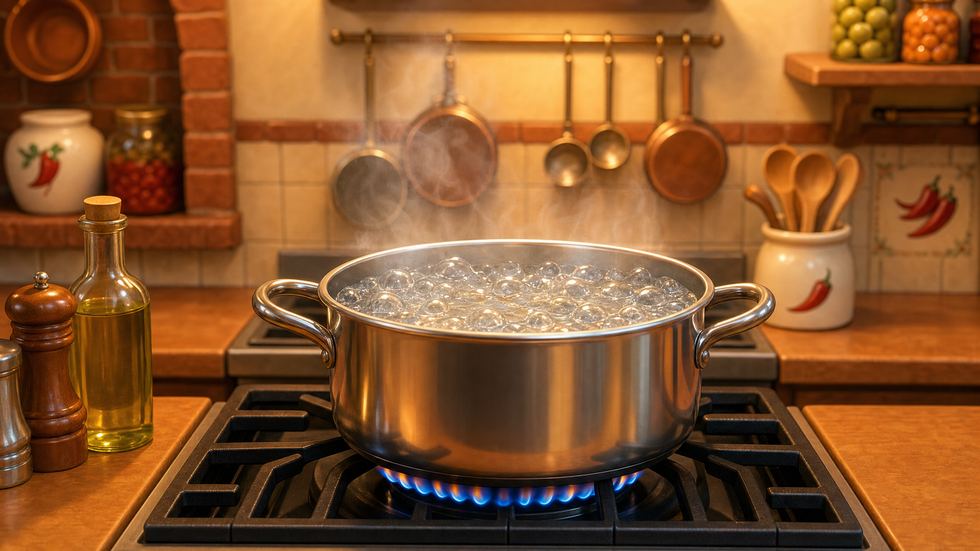
A real rolling boil first. The salt goes in here, before the pasta. -
Taste the water before anything goes in
Ten grams a litre, and then your own tongue as the second opinion. This takes four seconds and it is the only chance you will get — pasta cannot be salted afterwards. Salt on the outside is not the same as salt in the pasta, and everybody can tell.
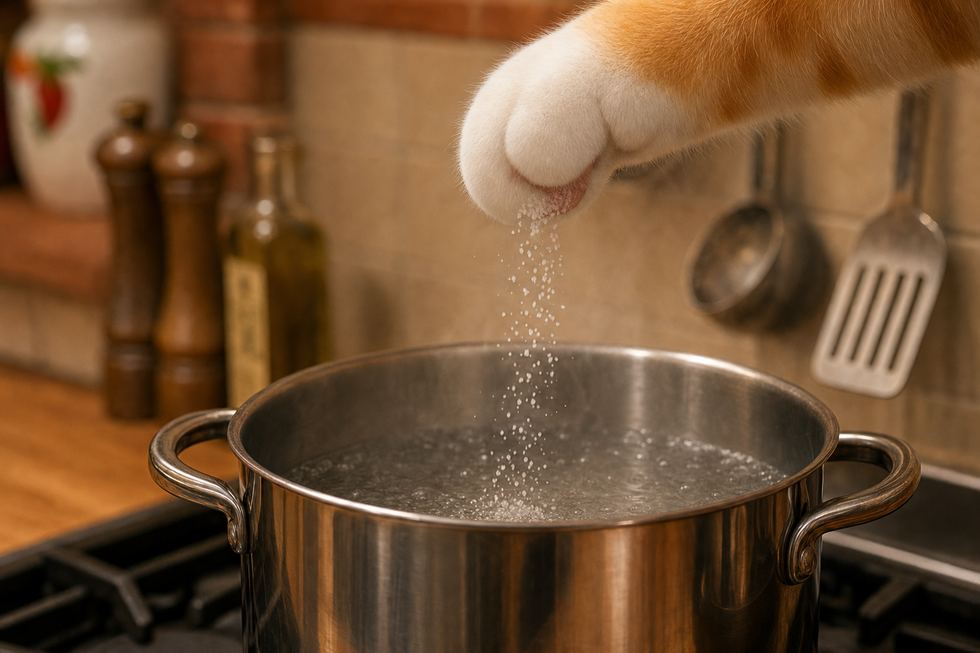
Ten grams a litre, then taste it. This is the only chance the pasta gets to be seasoned from the inside. -
In goes the pasta — whole
Long pasta goes in whole. Stand it in, wait a few seconds for the ends to soften, and press it gently under with the spoon. Do not break it. The length is the point: it is what lets the pasta twist around a fork and carry sauce with it. Break it and you have made something shorter and sadder that a spoon must chase.
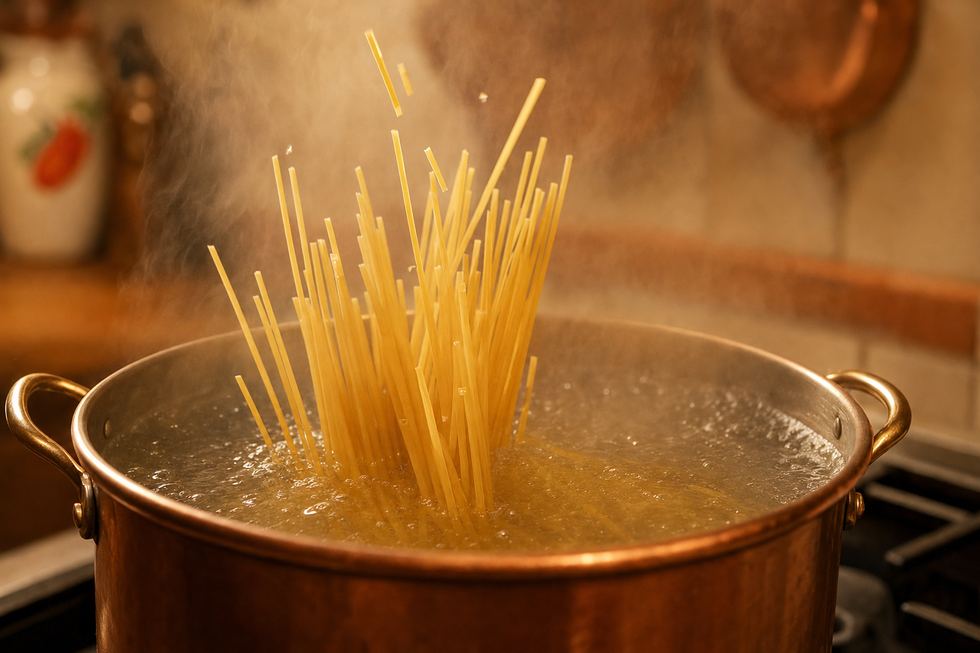
Whole. Stand it in, wait a few seconds, press it under as it softens. -
Stir in the first minute, and mean it
The first minute is when the surface starch is at its stickiest and every strand is looking for a friend. Stir properly — several times, right to the bottom. After that minute the danger has passed and you can leave it alone. This one minute is worth more than any amount of extra water.
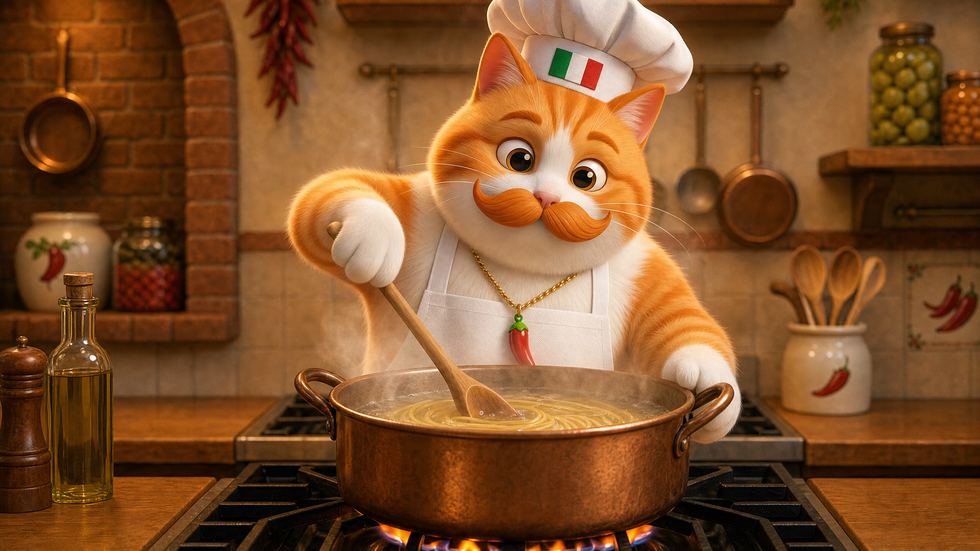
The first minute, properly, right to the bottom. This is what stops it sticking — not the size of the pot. -
Taste it before the packet tells you to
Start tasting two or three minutes early. The packet time was written by somebody who has never met your stove, your pot or your altitude. Al dente is firm resistance in the centre and no chalky white core — you are looking for the moment just before you would call it ready.
And if the pasta is going to finish in a pan, take it out earlier still. It keeps cooking in there, and it must arrive with somewhere left to go.

Start tasting two or three minutes before the packet says. Your teeth decide, not the clock. -
The water first. Then the drain.
Before you tip anything anywhere, take out a mug of that cloudy water and put it somewhere you will not knock it over. Then drain — and do not rinse it, ever. Rinsing washes off the exact starch you spent twelve minutes making.
No oil in the water either. It does nothing but float, and later it makes the sauce slide off the very pasta it was supposed to be protecting.
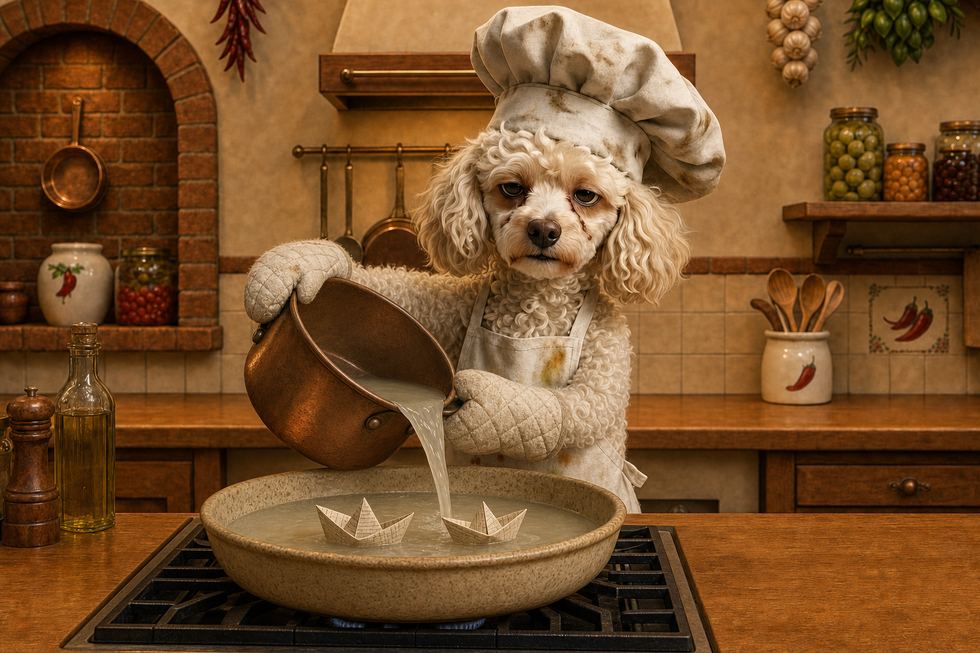
The mug of water comes out first. Then, and only then, the colander.
When it goes wrong
- It came out as one solid lump
- The first minute went unattended. Nothing to be done now — next time, stir properly in the first sixty seconds and it will not happen again, however small your pot is.
- I salted it and it still tastes of nothing
- Either the salt went in after the pasta, or there was far less of it than you think. Ten grams a litre is more than most people can bring themselves to add. Taste the water, not the packet.
- It went soft while I was doing something else
- The packet time is a suggestion, and it is always the outer limit. Taste early. Overcooked pasta cannot be brought back, and in a pan it will only get softer.
- I poured the water down the sink
- Then the sauce will have to manage without it, and it will show. Plain hot water is not a substitute — the starch is the whole point. See the water from the pasta.
Once it is out of the water, the dish is still not finished. What happens in the pan in the last thirty seconds is its own technique — mantecatura.